
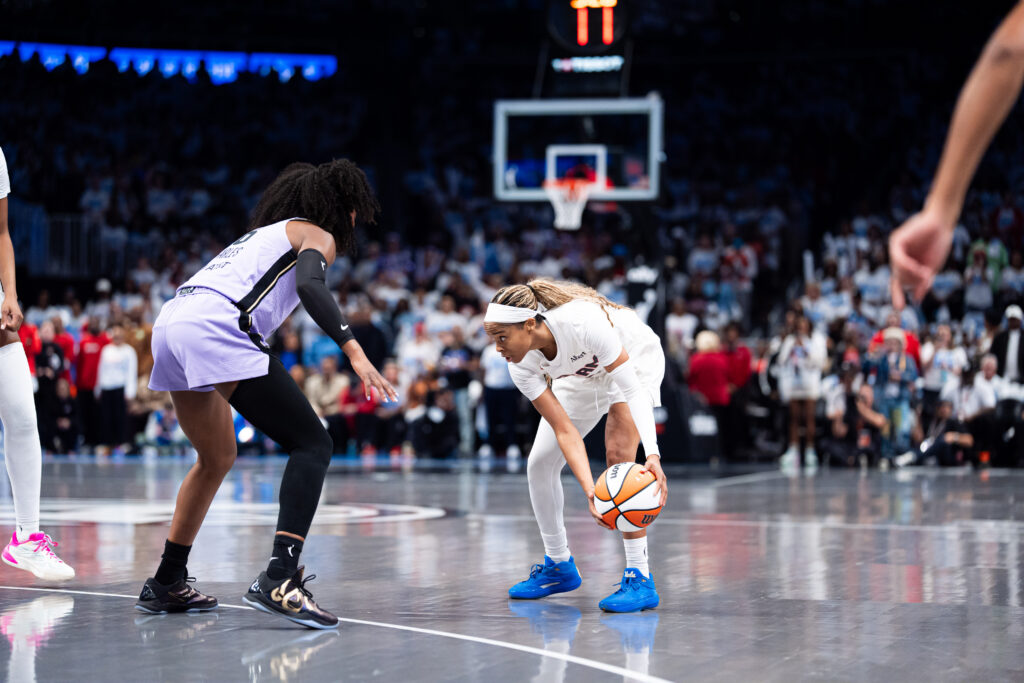
ATLANTA (Oct. 24, 2026) — The Atlanta Dream had an opportunity to move within one victory of their first WNBA championship Saturday afternoon, but the Golden State Valkyries had other plans.
Behind a dominant defensive performance and a record-setting afternoon from Kiah Stokes, Golden State defeated Atlanta 71-62 at State Farm Arena, evening the best-of-seven WNBA Finals at 2-2 and shifting the championship battle back to San Francisco.
After delivering a commanding 97-71 victory in Game 3, the Dream struggled to find their offensive rhythm against a Valkyries defense that disrupted passing lanes, controlled the paint and forced costly turnovers.
Atlanta entered halftime trailing 42-26, its largest deficit of the championship series. Although the Dream mounted a second-half comeback and trimmed the margin to five points, Golden State maintained enough control to secure the victory.
Rhyne Howard led Atlanta with a game-high 19 points and eight rebounds, providing much-needed offense as the Dream attempted to erase the deficit.
Angel Reese made her presence felt defensively, tying her playoff career high with three blocked shots. Veteran DeWanna Bonner also reached a postseason milestone, moving into 12th place on the WNBA’s all-time playoff offensive rebounds list.
However, Atlanta’s offensive struggles proved difficult to overcome.
The Dream committed 14 turnovers in the opening half, tying the WNBA Finals record for the most turnovers in a half. Combined with just 26 first-half points, the mistakes placed Atlanta in a difficult position before the third quarter began.
Golden State capitalized early, using a 12-0 first-quarter run to take a 16-11 advantage entering the second period.
The Valkyries continued applying pressure in the second quarter, putting together a 22-7 run to extend their lead to 16 points at halftime.
Atlanta responded with greater urgency after the break, opening the third quarter on a 9-2 run that helped reduce the deficit to single digits.
The Dream eventually pulled within five points, but their inability to consistently convert offensive opportunities prevented them from completing the comeback.
Golden State’s defensive execution was particularly effective around the basket, where Stokes delivered one of the most impressive performances of the postseason.
Stokes collected a playoff career-high 16 rebounds, including eight offensive boards, establishing franchise postseason records in both categories.
Her eight offensive rebounds also tied for the second-most in a WNBA Finals game.
Stokes continued her remarkable postseason shot-blocking performance, becoming the WNBA’s all-time leader for blocks in a single Finals series with 13.
She also became the first player in league history to record at least three blocks in four consecutive Finals games.
With 26 blocks this postseason, Stokes moved into fourth place on the WNBA’s single-postseason blocks list, trailing only performances by Lisa Leslie and A’ja Wilson.
Her seven postseason games with at least three blocks also established a league record, further demonstrating her defensive impact throughout Golden State’s playoff run.
Stokes’ rebounding performance moved her to 324 career playoff rebounds, placing her 16th on the WNBA’s all-time postseason list.
Gabby Williams led Golden State offensively with 17 points, finishing as one of five Valkyries players in double figures.
Cecilia Zandalasini contributed defensively, tying her playoff career high with three steals.
While Golden State received balanced scoring, its ability to control possessions and protect the basketball proved equally important.
The Valkyries committed just nine turnovers, surrendering eight points off those mistakes. Atlanta finished with 18 turnovers, which Golden State converted into 16 points.
Golden State also held a significant advantage in the paint, outscoring Atlanta 38-28 in that area.
The physical, defensive nature of the series has made efficient scoring difficult for both teams.
Through four games, Golden State is shooting just 34.3 percent from the field, while Atlanta is connecting on 37.8 percent of its attempts. Those figures rank among the lowest shooting percentages recorded in WNBA Finals history.
For Atlanta, Saturday’s 62-point performance marked its lowest scoring output of the season.
The Dream’s three lowest-scoring games this year have all come against Golden State, including 64 points in Game 1 and 66 points during their June 24 regular-season meeting.
Those struggles underscore the challenge Atlanta faces against a Valkyries team capable of disrupting its offensive flow and limiting opportunities inside.
After winning Games 2 and 3, the Dream appeared positioned to take a commanding series lead. Instead, Golden State’s response has turned the championship matchup into a best-of-three battle.
Atlanta will need to address its turnover problems, improve its offensive efficiency and find more consistent scoring contributions beyond Howard as the series continues.
The Dream have already demonstrated their ability to respond to adversity, bouncing back from their Game 1 defeat with consecutive victories.
Now, with the championship hanging in the balance, that resilience will be tested again.
Next up: The Atlanta Dream travel to San Francisco for Game 5 of the WNBA Finals on Monday, October 26, at 8 p.m. ET at Chase Center. With the series tied 2-2, the winner will have an opportunity to clinch the championship in Game 6 on Thursday, October 29, in Atlanta.
You may also like
-
Atlanta Vibe Look to Build for the Future Ahead of 2026 Major League Volleyball Draft
-
Hawks Hold Off Thunder 117-112 Behind Okongwu’s Big Night and Johnson Triple-Double
-
Falcons Fall to Chiefs 35-13 Despite London’s Big Day and Historic Onside Kick
-
Hawks Rally Past Bucks as Road Trip Continues to OKC
-
Falcons Fall to Chiefs 35–13, Late Rally Not Enough